Calisthenics was an unknown and unpopular term before the running decade. People earlier thought it as a cardio type exercise. But now calisthenics has become the most popular workout as tons of videos about calisthenics have been uploaded on different social media platforms that have made it easy even for a non-exercising person to learn more about it. Certain incredible feats of strength through calisthenic workouts such as handstand push-ups, one-arm pull-ups and one-leafed squats are considered best examples of the calisthenics.
Therefore, Online Health Point has brought a complete guide to Calisthenics Workouts for you. The article includes authentic information about Calisthenics, what they are, how to do them, what are their benefits and which type of exercises are included in it.
What is a Calisthenic Workout?
Calisthenics is a special form of exercise in which you use just your own body weight as resistance. This is different from their body-weight workouts, where you need extra equipment and weights. For calisthenics workout you just need to alter your intensity along with a change in body angle.
This means when you do standard push-ups during calisthenics, you try to target your shoulders but the correct way is to put weight on your hips.
Thus calisthenics workout is defined as a series of bodyweight exercises that can be customized according to your fitness levels and are performed in a sequence. It also covers all your tasks including increase in strength and building muscles.
Performing such exercises in a sequence is ca;lled as calisthenics routine. Basically the calisthenic routine consists of customized exercise that fulfills your requirements according to your desired fitness level.
Common examples of calisthenic exercises include:
- Regular push-ups.
- Pull-ups.
- Jumping jacks.
- Pistol squats.
- Lunge.
- Chin-ups.
Benefits of Calisthenics Workout
Fitness journeys usually require weight lifting but lifting weight makes you skeptical about moving over to exercise progressions.
Contrary to this, calisthenics workouts are associated with several benefits, such as:
Total Body Strength
Calisthenics teach you that you don’t need any weight to become a stringer. These exercises help you build your total body mass and strength. You just need to challenge yourself consistently by bringing change in your stability, flexibility, angle and number of legs and arms you’re using.
Flexibility and Convenience
You will be surprised to know that calisthenics can be performed anywhere, anytime. There’s no restriction of space and time to do this exercise. So, you just do it whether you’re at home or traveling to another city. You can do this workout whenever and wherever you want.
Low Impact
Calisthenics are the perfect choice for those who are dealing with joint pain or a muscle injury. These excuses do not put excess stress on your body. So you can keep your fitness journey on track by performing calisthenics. These exercises teach you to use your own buddy weight. Therefore, they are easy to perform.
Improved Coordination
Coordination is the main requirement to perform a high level and well balanced exercise. Especially burpees and squats which engage multiple muscle groups at a time needs more coordination. These exercises help you promote coordinated movements along with improved performance and fitness.
Enhanced Mobility
Push-ups and squats are some examples of calisthenics that are performed with full range of motion. This thing helps you improve your flexibility and mobility, which is a big need for people who’re getting older.
Time-Efficient
Calisthenics are time saving exercises because you don’t need a specific space or time to perform them. You can perform calisthenics within 20-30 minutes at any place.
Types of Calisthenics Workout
It is true that you have a firm belief that calisthenics is your dream exercise that can fulfill all your fitness requirements. Therefore, you’re eager to add calisthenics as your basic workout routine but unfortunately you have no idea where to start and what type of calisthenic exercise is best for you.
To resolve this issue, take a calisthenics workout plan for your total body workout routine. This means you should arrange your workout in a way that includes every inch of your body. For this, you should focus on the five major types of calisthenics that are categorized on the basis of five major muscle groups in your body. Arranging your workout routine while following these types can help you improve your overall fitness.
Five major muscle groups for arranging types of calisthenics include:
- Lower body anterior chain.
- Upper body upper push.
- Lower body posterior chain.
- Upper body pull.
- Core circuit.
Lower Body Anterior Chain
It is best to take an initiative with the lower body and anterior chain. These compound exercises engage the most posts in front of your lower body. Therefore, you can start with a focus open quadriceps that include four sections of muscle fibers, such as:
Vastus Medials: It focuses on the extension of the knee because vastus medials are located in the center of the quad that is near the inside of the knee.
Vastus Intermedius: This is also near the center of the quad but its location is in the middle of the knee beneath the muscle. It is also involved in knee extension but can’t be seen like other parts.
Vastus Laterals: It is situated on the outside of the knee. It also helps in knee extension.
Upper Body Upper-Push
At the next step, you need to engage your body with exercises that target the upper body muscles, especially those which perform pushing actions.
Upper Chest: Parallel inclined push-ups and handstand push-ups are calisthenic exercises that activate your upper chest muscles .
Middle Chest: Standard push-ups are the right choice to target the middle chest muscle fibers.
Lower Chest: If you want to activate your lower chest pecs, you should go for traditional decline push-ups.
Shoulder: Front Delt: Regular push-ups are cylinder bets for first shoulder muscles that are located at front deltoids.
Shoulders: Middle Delt: These muscles can get more strength by performing seated Arnold press and lateral raises.
Lower Body Posterior Chain
Now, it’s time to head back to the lower body. You need to focus on the muscle group on the back of your body. The calisthenics that focus on the lower body force you to make slight changes in your positioning so that your focus may be shifted away from quad dominance to glute dominance.
Your leg has two strong muscles located at the back of leg i.e hamstrings including:
Biceps Femoris: These muscles are located at the outside of the hamstring. Romanian Deadlifts are a good choice for strengthening this muscle. Other types of calisthenics like Single-Leg Dead-lift can also target their flexibility and mobility.
Semitendinosus: These muscles are located on the inside of the hamstring. Single leg exercise is great for the muscles. But Box Jumps can also improve their strength.
The Adductors: Their location is inside of your legs. People often overlook these muscles while doing fundamental exercises and target other muscles.
Upper Body Upper Pull
After covering the front of the upper body you may review the other sides. The next step is pulling exercises that are a great necessity of the muscles at the back of your body. Common calisthenics for this session are pull-ups and Assisted pull-ups. More examples are jotted below:
The Lats: Simple pull-up bars can activate the largest muscle on the back, known as latissimus dorsi. Pull-up is the most popular bodyweight exercise that targets lats.
Upper and Lower Traps: Another large muscle group to your back, to the North of lats is called upper and lower traps. A common example of effective trap exercise is Shrugs.
Rear Delts: It is about your posterior shoulders. It is the center of your back and directly involved in your buddy’s stability and flexibility.
Core Circuit
Now, you have reached the most important mushes of your body, the core musculature. Your core is the place from where all basic and advanced movements originate. You should target each part of the core while practicing calisthenic workouts.
Here’s a list that contains all important core muscles!
Rectus Abdominis: You may know this muscle as six-pack muscles. People often assume these muscles as an additional beauty of their body but they are a;so important for your overall core strength.
These muscles or abs remain attached to your ribcage that helps them movie freely i.e up, down , right and left. These movements produce flexion in your torso.
External and Internal Obliques: These are muscle fibers that not only determine the direction of movement but also improves the function. External obliques help rotate your body while the internal obliques run to the opposite direction of external ones. During twisting calisthenic exercise both obliques control rotation of the body.
Transverse Abdominis: This muscle looks like a waist-band around your waist that helps maintain your stability and balance.
Are Calisthenics Enough for Building Muscles?
Calisthenic workout is closely linked with muscle building. People intentionally do these exercises specifically to build their muscles. So, if you’re interested in maintaining good muscle strength and muscle mass along with focusing on reconditioning, go for calisthenic workouts.
In addition, Calisthenic exercise emphasizes that one should set goals for themselves because progressions and regressions of movements can be controlled by you only. You can make them easy and light at the beginning or challenging as the time passes.
Moreover, research has shown that calisthenics are totally effective for you if you’re already lifting for years and now want to indulge your body into different forms of muscle growth. So, it is necessary to try some advanced exercise variations.
As calisthenics is resistance training, you can only create a difference in resistance during exercise. But you don’t need to use any external weight like holding a dumbbell or barbell. These external weights prevent you from engaging in an effective fur of resistance training.
If you dig calisthenics in the correct way, you can achieve your goal in a short time. The thing you have to take care of is the selection of the right exercise. Learn to perform the right exercises correctly and remain consistent with your calisthenic workout routine. Over time, your muscles get stronger and you want to add more challenging exercises to your calisthenic workout routine. The stronger niches appeal to you and arouse an urge to do the exercise consistently and appropriately to enhance certain variables such as frequency, intensity and duration.
Examples of The Best Calisthenics Exercises
Here are top pickles for the best bodyweight exercises that engage your legs, back, chest initially and then work around your whole body to enhance stability in your core muscles and improve support.
Levitation Squat
This is the first calisthenics exercise that involves your legs. This is easier for beginners but expert lifters also do it to improve muscle power. This exercise allows less knee flexion that makes it pain free movement. This also allows you to tap into an overload that is possible with a single leg but it has no negative impact like Pistol Squats.
Glute Ham Raise
This exercise combines both hamstring activation and glute activation. It focuses only on mechanics and function of muscles. This exercise allows safe contraction of hamstrings that are associated with driving, contracting and stabilizing of glute and hamstrings both.
Pull-Ups
This is the first upper body exercise which involves major muscles of your back. Pull-ups are considered the best movements for stabilizing the entire back and lower lumbar para-spinal muscles.
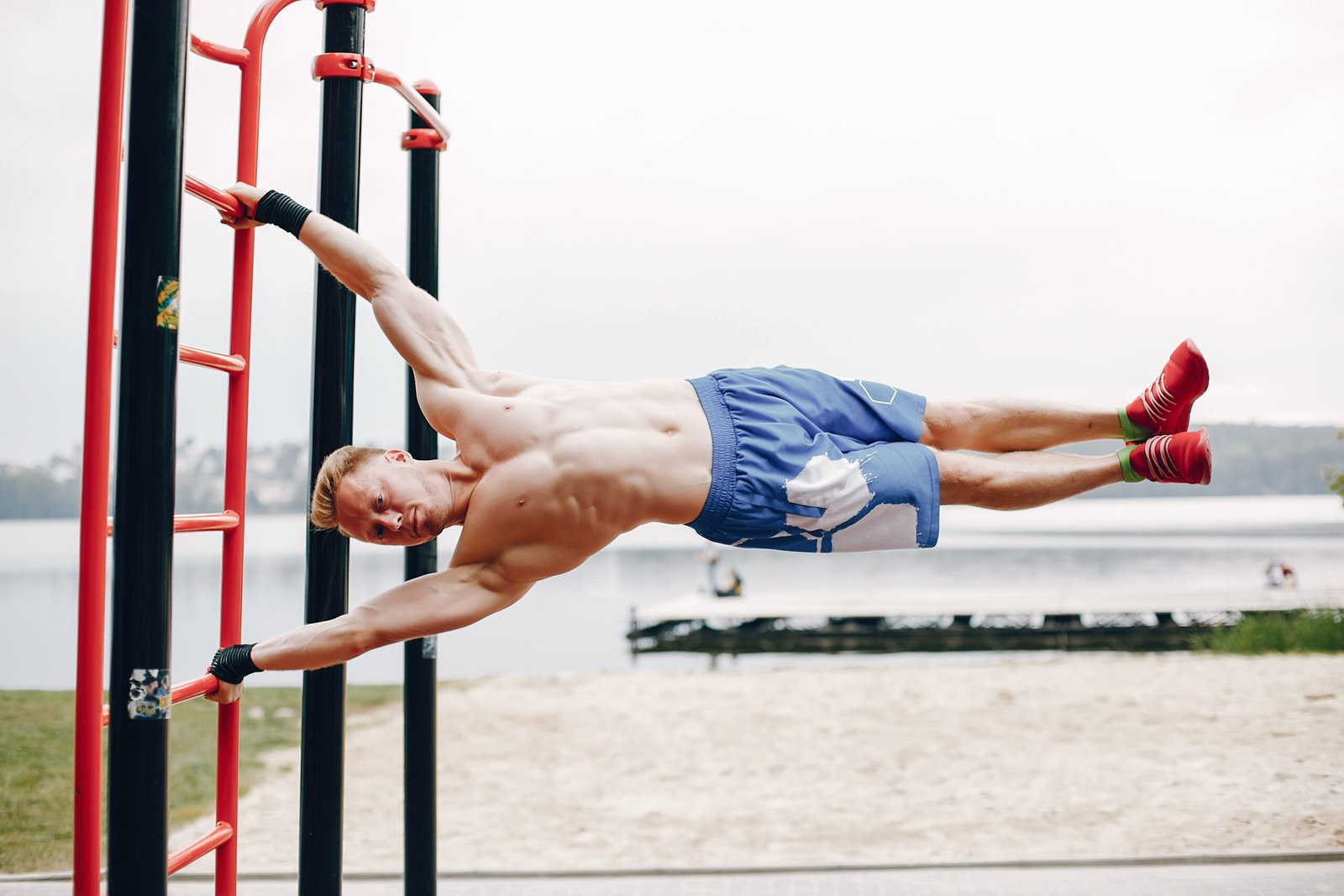
Human Pullover
Human Flag exercises are also known as human pullovers. People often take them as excuses but it’s not true.
These exercises actually engage your lats from top positions to the bottom, and ensure your ability to overload the muscles. This movement also improves your upper body muscle endurance.
Utilizing the entire bodyweight and hitting the karts must helps you having great gains in muscle development and muscle strength.
But remember, avoid curling your trunk up by using your abs. Try Straight Arm Push-downs to get your body up. Keep trying these exercises for best results.