

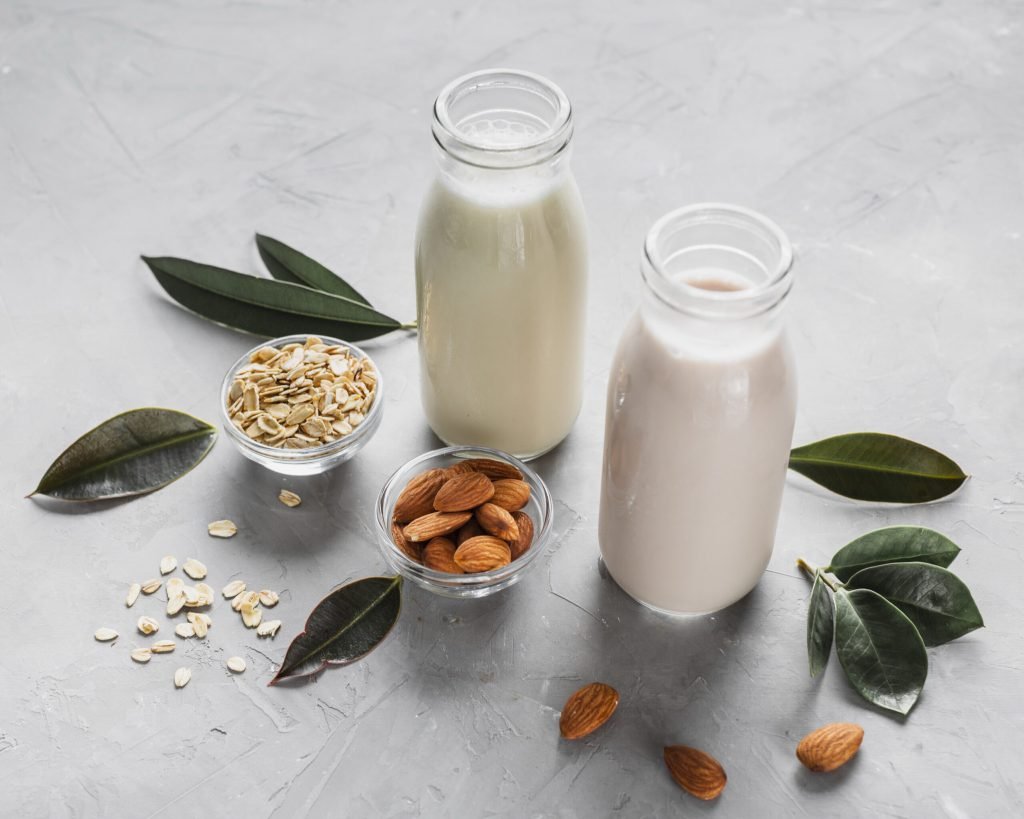
Do you know plant-based diets emphasize on eating and drinking only plant-based products? But when you think about plant milk, you may not find many options for nondairy milk. However, modern research and scientific technologies have provided a lot of options for nondairy or Plant Milks. The only reservation about these nondairy milk options is to choose the best one while considering their environmental impacts.
Although dairy products, nowadays , are also not completely safe for use, due to impurities and harmful chemicals used to preserve them for longer duration make the dairy milk hazardous to your health. But that doesn’t mean that plant-based milk is free from impurities or harmful impacts.
According to research, the nondairy milk gained through natural resources has more eco-friendly consequences as they are responsible for protecting the environment from natural disasters like greenhouse emissions and global warming.
In this article, you may learn about how various plant milks impact your environment and what things you should focus on while choosing the most eco-friendly nondairy milk.
Environmental Effects of Plant Milks
The resources a plant needs to grow and the footprints it leaves behind are the factors that help you to compare environmental effects of various plant milks. So it’s important to learn about what type of resources a plant uses to produce nondairy milk.
Many studies have shown that the comparison between different types of plant milks including oat, rice, almond, soy and dairy milk, helped to conclude that nondairy milks are more useful than dairy milk for the planet and your health. Dairy milk has a higher percentage of greenhouse gases that affects the quality of milk. While the plant milks do not need any natural resources to raise animals . That’s why they are safer to use.
However, one thing to keep in mind is that if you’re using plant milk for producing milk on a commercial scale, it may require finite resources like water and land. Their growth also creates some harmful impacts such as the production of greenhouse fire gases like methane, nitrous oxide and carbon dioxide, which ultimately increases the global warming effects on earth. But still experts agree with the idea that plant-based milks have various pros and cons. Which environmental factor is important so you can help to decide what plant milk option is best. Exploring available researched data also can help you choose the best option.
Still, there’s no authentic way to rank the environmental impacts of plant milk. Just some research results are helping to learn that avoiding rice or almond milk is necessary to sport out water use concerning issues. Similarly, if you’re concerned about land use, trying to avoid oat and soy milk production may be helpful. So, the better options include coconut, pear and hemp milk.
Let’s have a look to learn more about the production and impact of various plant milks!
Soy Milk
Production of soy milk needs a large area to meet the demands. Therefore, it is considered the biggest driver of deforestation in the Amazon rain-forest. According to studies, producing just 1 liter of soy milk needs around 2.8 square km of land per year.
This is also a reality that the majority of soy crops are grown to feed livestock and produce bio-fuel. It is not just grown to produce soy milk for humans on the planet. In addition, research has shown that a very small amount of soy milk is also used to grow for direct consumption by humans.
According to a recent estimation, around 40% of global soy production is dined in the country. But the relaxing thing is that, the government has made an agreement with Amazon Soy Moratorium, to not to sell soy grown using their land to common traders. This may help decrease deforestation.
In addition, some soy milk companies also claim that they use only organic soybeans to produce soy milk which shows that Amazon deforestation has been stopped. As soy needs a large land area to grow, it is not suitable for the environment but never forget that it also offers many benefits. Like other legume plants, soy also helps fix nitrogen in the soil that directly helps to reduce use of nitrogen fertilizers.
Almond Milk
When you talk about moist water-intensive plant milks. Almond milk ranks first. It requires a significantly larger amount of water than oat milk or soy milk. According to a 2024 study, producing 15 liters of almond milk needs 4.5 gallons of water and that quantity is just sufficient to meet the demands of acuity.
In Australia, researchers have done a comparative study to find the water footprints of nine crops. The result showed that almonds had the highest footprint this more than carrots, potatoes, grapes, apples, oranges, cherries, and oranges. This means almonds use a lot of water that makes it unfit to grow in the areas with water scarcity.
Moreover, approximately 85% of almond production is done in California, which causes an extreme doubt in recent years which ultimately threaten the water resources. Studies also show that nuts also require more land resources than rice milk but less than oatmeal.
Hemp Milk
This hemp plant is the highest yield plant because almost all of its parts can be used and it is the most eco-friendly plant that produces plant milk. Its almost all parts are used for different purposes like its roots and stalks are used to make construction materials such as hemp paper, plastics and textile fibers while its seeds and fruits are useful for the manufacture of milk and oil.
In addition, it has a natural ability to resist disease. It also makes shade that helps reduce weeds. Research also suggested that a little amount of pesticides and herbicides are required to grow hemp plants. Its deep long roots also nourish the soil in which they grow. Last but not least hemp milk also has various health benefits.
Rice Milk
Rice milk is the greatest cause of increase in the percentage of greenhouse gases. Rice paddies contain specific types of bacteria that produce a large amount of methane when the crop grows in flooded areas. In fact, rice crops are usually grown in the areas flooded with water. This means rice requires a lot of water to prudence rice milk. But when you talk about land resources for rice crop, it uses less load than almond, soy and oats. Last but not least. Rice containing a large amount of arsenic can contaminate nearby water resources.
Oat Milk
This is a mono-culture crop that is grown on a large-scale. Oat is the only crop that can be grown on the same land repeatedly. Being a mono-culture crop it reduces the biodiversity in the ecosystem around itself. These factors increase the number of pests and the use of pesticides becomes indispensable. Its mono-culture nature also makes it unfit for nutrients protection. It deletes nutrients present in soil that ultimately ends in reduction in soil fertility.
A specific type of pesticides known as glyphosate-based pesticides are used to grow oats. The ostriches help promote growth and stop the growth of pathogens. But it has an overall negative impact on insects, plants and animals.
Studies show that oat plants emit fewer greenhouse gases, use 50% less energy and 70% less land than dairy milk.
Moreover, some researchers also support the idea that oats need more land resources to grow properly than rice, soy and almond. When it comes to water resources, posts requiring oats require water more than soy but significantly less than rice and almond.
Pea Milk
The areas that have a significant amount of rainfall throughout the year tend to have a great growth of peas. This means peas can grow near areas that have less water resources. They don’t need a lot of irrigation. Their irrigation patterns are usually irritated by the farmers. This rotation is useful for natural fixation of nitrogen in the soil that ultimately lowers the demand of fertilizer.
In addition, scientists still don’t find a way to modify the peas varieties genetically resistant to herbicides like soybeans. Research also suggests that pea milk needs less amount of greenhouse gasses than almond milk.
Coconut Milk
There’s not much information known about how coconut milk impacts the environment but research suggests that coconut milk is responsible for half of the greenhouse gases emission around the world. It is a greater percentage than soy milk. Coconut trees need a low amount of water for their proper growth. They are well-known for being natural carbon sinks. This means they tend to absorb larger amounts of carbon dioxide from the environment and produce more oxygen than other milk plants. That’s why coconut milk is constructed suitable for overall carbon emission.
However, these trees are just grown in tropical areas. They are also considered having impacts for the biodiversity of native species. But some research also shows that coconut is actually good for promoting biodiversity and never threatens the ecosystem’s balance.
How to Prepare Plant Milk at Home?
This is the more eco-friendly way to prepare your plant milk at home. You can control the amount of ingredients while making it by yourself.
According to standard recipe for preparing 5 cups or 1 liter of milk at home, you require:
- 100 grams of rolled oats.
- 700 mL water.
- A pinch of salt.
- Half tablespoon of vanilla extract.
- 2 pitted Medjool dates.
Recipe
- Take a food processor or a high speed blender to mix all these ingredients. Process them for 60 seconds until the mixture takes a creamy look. Avoid over-blending, as it can make the mixture slimy.
- Use a thin cotton towel to strain the liquid and remove the debris.
- Keep the strained milk in a container that should be sealed. Refrigerate the milk for at least five days.
This is the homemade plant milk that can be used as a store-bought plant milk. You can use it for making smoothies, cereal, and batter for baked goods.
How to Choose the Most Eco-Friendly Plant Milk?
Environmental footprints are the well-known factors that help you choose what type of plant milk is the best option. Research suggested that the least environmental impacts make pea, coconut and hemp the most suitable plant milks than other varieties.
Rotating between a few kinds is the best way to fund which plant milk you should choose.
In addition, if you want to reap some beneficial impacts of nutrients found in the plant milks, you should look for the nutrients used in the composition of the milk. For example, people who want to pass fortified nutrients like vitamin D or B12, they should prefer soy or pea milk.
The next important factor is packaging. Prefer to buy plant milk that is available in a recyclable container. It also helps reduce waste.
Another way to choose the best option of plant milk, is to purchase an organic plant milk. This thing can help reduce pesticides and genocide use, which results in contamination of water, air and biodiversity.
Plant milk pre roasted at home is also the best choice. You can prepare them by using raw legumes, nuts or grains.
Conclusion
Plant milks are the most favorable for the environment as they have smaller footprints than dairy milk. But it is also a reality that they are not complete without footprints. According to available research, there are some fruits that help decide which is the most eco-friendly plant milk is the best option for use. Different plants impact your ecosystem in different ways. They have various impacts on the resources like land, water and greenhouse gas emissions.
The available data shows that oats are extremely land-intensive, rice emit excess greenhouse gas while almonds use a lot of water. So, it is good to go for pea, hem or coconut milk.
Along with all these, you should also keep an eye on the facts that can minimize the environmental impacts. So, prefer to choose the one with recyclable packaging, organic ingredients. You can also prepare it at home.